

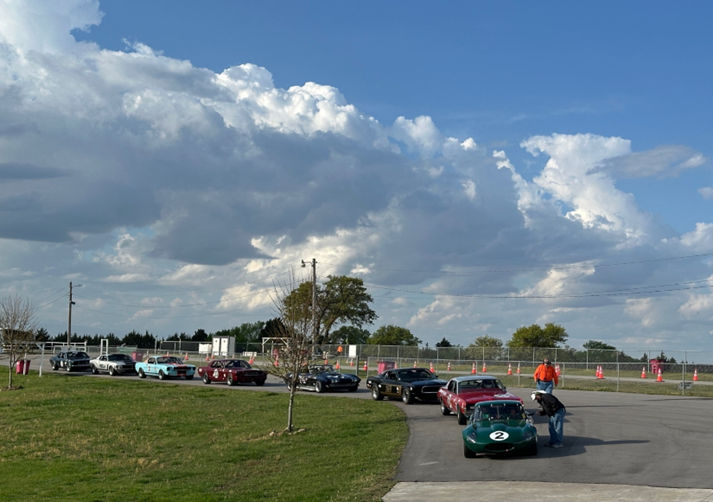
We arrived at the track about 5 pm, and set up our paddock in our covered Race Port. The Friday schedule called for 4 practice sessions, which would be a perfect opportunity after a six-month lapse since October. The XKE Coupe went through numerous improvements over the winter, installing a new clutch, replacing the rear end and fixing oil leaks. We also installed a new electronic system called Flagtronics. Flagtronics is a wireless in-car and track side sign board displays offer notification of changing course and sector conditions. Safety officials can have added peace of mind knowing that drivers have been notified of hazards on course. This is now a required element at many raceways.
The schedule called for 5 racing groups, with 16 cars in our race group. Our race group included Mustangs, Corvettes Camaros, 2 XKEs, a Dodge Dart, Shelby 350 Mustangs, Porsche 911s, Ford Falcon, and a Savinelli. It was really nice to see my old friend Scott Young with his Red XKE Coupe once again.
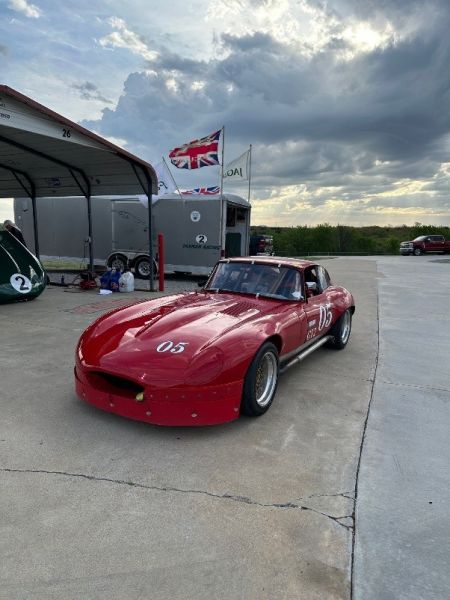
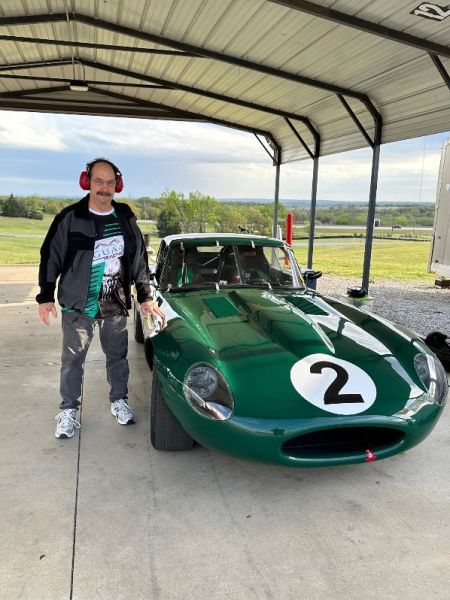
Friday started out clear and a little windy. My goal was to stay in the rear of the pack and get comfortable with the car and track once again. All went well with the first practice session, with lap times between 1:48 and 1:52. We decided on 18 PSI for the front tires and 19 PSI for the rear, as the track surface was rather cold. The track has been recently resurfaced, so traction was excellent. I started to pick up the pace a bit on the 2nd practice with less braking and more speed. I was now running in the middle of the pack and had lap times consistently at 1:46. We grilled some brats during the lunch break, but then the rains came and what a downpour! It washed out the remaining two session on Friday. So off we went to enjoy steak dinners at our favorite steakhouse, Mugsy’s Grubhouse, in Yale, Oklahoma.
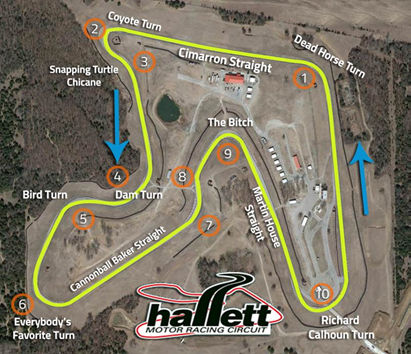
Saturday brought perfect racing weather with cool dry air, slightly overcast, 70 degrees and light winds from the north. The schedule called for 1 qualifying race then 2 sprint races. I improved my lap times to 1:43 and qualified 5th. In the first Sprint Race I further improved to 1:40 and finished fifth overall. In the 2nd Sprint race, I was bumper to bumper the entire race with a Mustang and again finished 5th with my best lap time at 1:37. We only used our Goodyear Bluestreak practice tires for the first 5 sessions, saving the Hoosier TDRs for the races on Sunday. The Hoosiers tend to be 2-3 seconds faster per lap. These are my notes for how to run the best race line at Hallett Motor Circuit.
Turn 1
This turn can be taken much faster than what your car may make you feel. The approach speed for this turn is around 100 MPH. I downshift to 3rd and accelerate thru the turn.
Turn 2
Accelerate Straight uphill, blind to big turn at 3.
Turn 3
The complex at 3 includes a sharp left hander, followed by a short, easy left/right kink. The line here involves taking the car in very deep on the outside (right), then turning sharply in to apex. Speed drops from 100 mph to 30 mph. This is a give away turn. You just to slow down and get through it.
Turn 4
Is basically a decreasing radius curve that appears to start just below the crest of the hill. This turn, like all at Hallett, should be taken very deep, so that you exit on the far right side of the tarmac. There is a small white square painted at a sufficiently aggressive turn in point on top of the hill, on the left side. If your left front tire hits this square, your turn at 4 should position you well for an attack on 5. The transition from 4 to 5 comes fairly quickly on a hot lap - 3rd gear for me. The only braking required between 4 and 5 is to set your speed at the turn-in on four.
Turn 5
You get a lot of weight transfer to the outside as you approach turn 5 - especially if you don’t go deep enough into 4. A well-balanced car should be able to take this turn fairly quick, but heavier vehicles and hot tires can lead to a tank-slapper or shunt. You get back on-throttle before apexing turn 5, leading downhill to 6.
Turns 6 and 7
The complex at 6 and 7 is a double-apex turn. Carry the car very deep into 6 (late) on the right side of the tarmac, and look to a spot just past the white-red paint on the inside (just before the straight leading to turn 8). After making this turn properly, you should be back to full throttle exiting 7 fairly quickly. Again, like most turns at Hallett, you need to go in deeper than you'd anticipate, and use all the road.
Turn 8
Approaching 8, set the car with a brake tap quick and hard once, taking the left-hander somewhat deep. You see 3 telephone poles, aim straight for them as you accelerate up the hill, and it will take you right to the apex of eight and, with enough speed, carry you over to turn nine. Take a straight line from the inside of the first left-hander, close to the cone (apex) of the right-hander, and on to the bottom of the hill on the far left of the tarmac.
Turn 9
This turn is called “the bitch”. Coming out of 8 on-line and under late braking, you quickly return to throttle and apex 9 by touching the rumble strip on the inside (right), leading back out to the left rumble strip going up the hill to the back straight. Extend the turn very gradually to the right to set up for 10.
Turn 10
Approach the carousel at 10 from the far right, and brake very deep into the turn. Done properly, you can return to throttle quickly and stay on it, touching the inside rumble strip just before the storm grates. An approach into 10 in a road car should be between 80 - 100 MPH. Cars get it wrong here by using too much throttle too early, or not going deep enough - both often result in either a spin or an excursion into the field to the right of the track.
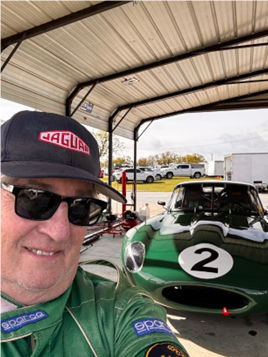
Unfortunately, the rains returned on Sunday and our final two races were cancelled. I accomplished what I set out to do and I’m ready for our next race weekend at Gingerman Raceway in South Haven Michigan on May 15th-17th. Once again, I can’t thank Mark and Richard enough from keeping the Jag “race ready” the entire weekend. It’s a ton of work and they really give it 100%. Philip Taxman